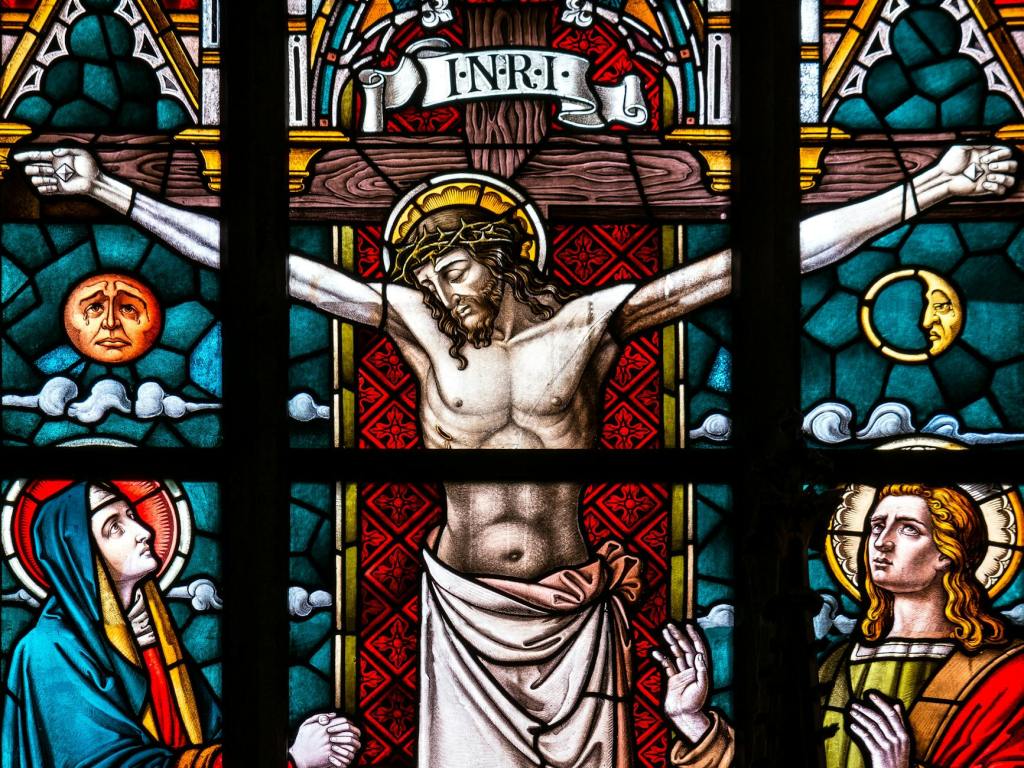
February 25, 2024 was Women’s Sunday at St. John’s Lutheran Church in Pomaria. They have kindly posted the video here: https://fb.watch/qFNnr4e22_
Mark 8:31-38
31[Jesus] began to teach them that the Son of Man must undergo great suffering, and be rejected by the elders, the chief priests, and the scribes, and be killed, and after three days rise again.32He said all this quite openly. And Peter took him aside and began to rebuke him. 33But turning and looking at his disciples, he rebuked Peter and said, “Get behind me, Satan! For you are setting your mind not on divine things but on human things.”
34He called the crowd with his disciples, and said to them, “If any want to become my followers, let them deny themselves and take up their cross and follow me. 35For those who want to save their life will lose it, and those who lose their life for my sake, and for the sake of the gospel, will save it. 36For what will it profit them to gain the whole world and forfeit their life? 37Indeed, what can they give in return for their life? 38Those who are ashamed of me and of my words in this adulterous and sinful generation, of them the Son of Man will also be ashamed when he comes in the glory of his Father with the holy angels.”
The disciples must have had some kind of theological whiplash from Jesus’ teaching in Mark 8. Mark is the fastest-moving gospel, and in the first 30 verses of mark 8, Jesus has healed two people from blindness, fed 4000 hungry followers, and taken his apostles to Caesarea Philippi. There, he asked them who they think he is and Peter made his famous confession. “you are the Messiah, the Son of the living God.”
Now that Jesus has made it clear that he is the Messiah, the Christ—a fact which he keeps telling people not to share—Jesus starts teaching about what that means.
I find it hard to blame Peter for what he thinks it will mean for Jesus to be God’s anointed one. He’s looking forward to the end stages, where Jesus will sit at the right hand of the Father in his glory. Peter doesn’t want to hear about the first part, where the Messiah will suffer and be killed.
We want our heroes to be glorious, too, don’t we? We want them to be attractive all the time, to be the best, to do the best, not to say anything that could possibly upset anyone, and to have enough money to accomplish their goals, whatever they might be.
If we listened to what advertisers tell us we should be, we’d be skinny or strong (preferably both) with bright white teeth. We’d be approachable but respected, and whatever age anyone else assumes is perfect. We wouldn’t have to deal with any pain, our families would always be well-behaved, and our houses would be immaculately clean. It’s a high bar.
What standards would we want to hold Jesus to, if we were being honest with ourselves? We might want Jesus to have the same ancestors that we do. We might want Jesus to hold the same political views. We certainly would want Jesus to be clean, dressed like a normal person, and to speak the same language we do. Right?
Jesus, unfortunately, refuses to hold to our standards. I don’t know about you, but I was not consulted about when, where, or to whom Jesus would be born. A lot of people in his era were surprised that his parents were poor—they couldn’t even make the regular offering at the Temple when he was born! Others were surprised that he didn’t work hand-in-glove with the religious authorities of the day. It’s scandalous, really, that those are the people who pushed hardest to silence him. Personally, I would have voted for Jesus to be born in an era where we could live stream the Sermon on the Mount. It would clear up a lot of questions.
But God doesn’t do it that way. God does things God’s way. The prophet Isaiah said that centuries before Jesus was born. In Isaiah 55:9, God says through the prophet, “As the heavens are higher than the earth, so are my ways higher than your ways and my thoughts than your thoughts.”
God doesn’t put Jesus on earth to be a celebrity. God sends his son, his only Son, to die for us, so that whoever believes in him might be saved. God isn’t interested in meeting our expectations. God is interested in doing what is necessary to achieve all righteousness. Jesus says that it is necessary for the Son of Man to undergo great suffering, and be rejected by the elders, the chief priests, and the scribes, and to be killed, and after three days rise again.
That doesn’t sound like good news. But it is. Our hope of the resurrection—our knowledge that Jesus did indeed rise again after all that—makes all the rest of it worth it.
God’s plan doesn’t sound like anything we would expect. It’s brutal, messy, dirty, and humiliating. But why would we assume that God’s plan for the universe looks like we would plan for anyway? We can’t predict what exactly we will end up with when we go to the grocery store. Jesus sees more than our eyes can see. Jesus opens new pathways where we didn’t know a road should be. This is what God does. The Israelites crossed into the Promised Land because God made a road straight across a river. We make it into the Promised Land because our Savior has walked the road of death before our feet got there.
Now, for the even scarier part of what Jesus teaches: Where he goes, we are called to follow. Or, as Jesus puts it, “if any want to become my followers, let them deny themselves and take up their cross and follow me.” There are still countries where Christians are persecuted unto death, even in 2024, but most of us are unlikely to be killed for confessing our faith. Our crosses are burdens, tasks, roles, callings that we take on for the sake of the gospel, and they can take many forms.
For example, I came down to start my studies at Southern Seminary on the last day of the summer Greek course. While my classmates were taking their final exam, I unloaded everything I owned from my blue Honda Civic with the bright yellow New Jersey plates. It was a day of many firsts—meeting new people, learning what it means to “bless her heart,” and, well, my first dinner here required some advance notice. My classmates had bought themselves a treat to celebrate the end of exams. One of them sat me down, put his arm around me, and said, “Now, have you ever been to a pig pickin’?” It was an experience.
So imagine my surprise when, just a year later, I found myself standing on a loading dock outside a butcher shop just down the street from the seminary. It was 6am, never my favorite time of day, and next to me, ready to be loaded into the back of a pickup, was a pig. Or most of one. It was destined to become that night’s Homecoming feast. And I looked around, sleepily, and thought in my best New Jersey accent, “How did I get here?” I wasn’t upset to be there. But it was certainly a morning like none I had had before.
As I pondered, I realized that I wasn’t there because of the unseen hand of fate, or economics, or any other impersonal force. I was there because of the call of God in my life.
Eating that barbecue was not a cross I had to bear. It was delicious. That said, seminary and the clergy life have had their hard spots. I live nearly 800 miles from my parents and brother. Pastors and deacons have weird hours, holy and challenging conversations, and expectations put on them by others that would be impossible if we tried to live up to all of them.
I believe that God has calls for each of us in different phases of our lives. They look different for different people, and they change as we change and as our life circumstances change. On that morning, I was called to be the keeper of the checkbook on behalf of my fellow seminarians. I was called to be a seminarian, to live faithfully as a single person, and to my various roles as friend, daughter, and sister.
Let me tell you, I hope that I will never be called to be a treasurer again. But now I have taken on the call of parenting, of pastoring, of bearing witness to what God is doing throughout South Carolina and the world.
I see the crosses that people bear for the sake of the gospel. It’s the things you might expect—the roles of leadership and servanthood around the church and in the world. It’s the people who serve on council, vacuum the hallways, teach Sunday School, and assist with worship. It’s also the things you might not expect. Caring for your aging parents is one of the 10 Commandments, after all. Bearing our crosses can mean taking care of others in deeply personal ways, or it can mean allowing ourselves to be vulnerable so that others can be vulnerable, too. It can be working a job that is deeply meaningful, or it can be working a job that pays well so that we can do other meaningful things with our lives.
Taking up our cross doesn’t mean suffering for no reason. It doesn’t mean that we can’t laugh or enjoy the beauty of this world God has made. It means that the gospel is worth dying for and worth living for.
When we take up our cross it also means that we don’t have to live up to anyone’s expectations but God’s. We don’t have to have the best of anything, and we don’t have to have the worst. We can serve in ways that might be unexpected for us, because the world doesn’t tell us who we are or what we do.
In Jesus’ earthly ministry, he often lifts up people in unexpected ways. Jesus called fishermen and tax collectors—the poor and the hated—to be his disciples and ambassadors. He traveled with women, some of whom funded his ministry. He talked to people that others thought he shouldn’t have, ate with people other people didn’t like, and died an awful death.
Women were some of the first to break the rules and do things beyond the role that society would have for them. They went from the perfectly acceptable job of anointing a dead body to becoming the first to share the good news that Jesus was risen. Men didn’t let their roles be limited, either. When the early church needed people to serve tables and feed the hungry in Acts, they chose men to be deacons, caring for and nurturing those in need. Calling and responsibility goes to those who have been chosen by God, not those that the world might appoint by default.
We can lift up ministries traditionally done by women—quilting, feeding, cleaning, nurturing, teaching—and we can celebrate that women’s work also includes preaching, doctoring, accounting, and leading. We can also lift up the roles that men have played throughout history, and give thanks for all those who made room for women to serve alongside them, as well as those who felt the call to serve alongside the women. I see you men, getting your dishpan hands, setting up communion on the altar, sending cards to folks on their birthdays and anniversaries. We all have crosses to bear, large and small, expected and unexpected. When we take up those crosses for the sake of the gospel, God is glorified.
God’s glory isn’t only with us when life is perfect. God’s glory takes us through our sin to the cross and on beyond death into resurrection. God’s glory is reflected in our every day moments of serving others. God’s glory shines when we do what we are called to do whether or not others expect people like us to do it. God’s glory shines most clearly in Jesus, who goes through everything, rejection, suffering, humiliation, and death, so that we can rise with him on the last day. We can do anything and everything through the power of God at work in us.

 Words About The Word
Leave a comment